
 Vanock
10 Jun 2024


10 Jun 2024
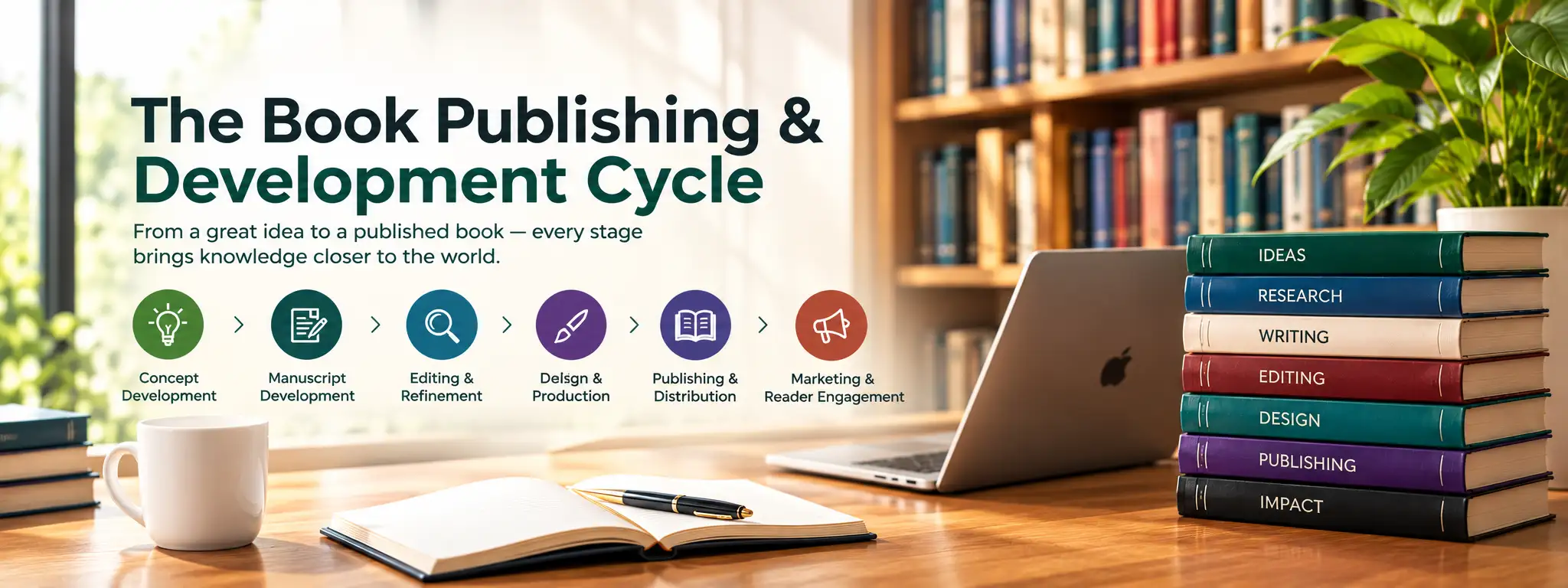
The book industry is constantly evolving. Ideas move from early concepts to development, publication, distribution, and eventually wider readership. These stages form a natural book development and publishing cycle.
Understanding this cycle is important for authors, publishers, sponsors, and anyone involved in developing books. While no project follows exactly the same path, recognizing each stage can help teams plan effectively, manage resources, make informed decisions, and create books that deliver lasting value.
At Vanock, we believe that successful books begin with strong ideas, thoughtful development, professional production, and a clear understanding of readers. By combining creativity with research, planning, and quality publishing practices, we aim to help promising books move from concept to publication and reach the audiences they are intended to serve.
The book development cycle refers to the stages a book typically passes through from its initial idea to publication and distribution.
Although every project is different, most book projects can be viewed through several key stages:
Understanding these stages helps authors, publishers, sponsors, and project teams know what needs to happen at each point in the development process.
Every book begins with an idea.
During the concept stage:
A strong concept provides the foundation for everything that follows.
At Vanock, we look for book ideas that can educate, inform, inspire, entertain, or provide meaningful value to readers.
Once the concept is established, the idea is developed into a manuscript.
This stage may involve:
The goal is to turn the original concept into a complete and coherent manuscript.
Different books require different approaches. A children's story, business book, agricultural guide, biography, and educational textbook may all require different development processes.
A strong manuscript usually requires several rounds of review before publication.
Editing may include:
Examining the overall structure, flow, purpose, and effectiveness of the book.
Improving grammar, clarity, consistency, wording, and readability.
Checking the final text for spelling, punctuation, formatting, and other errors.
This stage is important because professional editing can significantly improve the reader's experience and the overall quality of a publication.
Once the manuscript is sufficiently developed, attention turns to the physical and visual presentation of the book.
This may include:
For children's books and illustrated publications, visual development can be particularly important.
A professionally produced book should combine strong content with a presentation that is appropriate for its intended audience.
After the book has been completed and prepared for publication, it can move into publishing and distribution.
This stage may include:
The objective is to make the finished book accessible to the readers who can benefit from it.
Publishing a book is only part of the process. Readers also need to discover it.
Marketing and reader engagement may include:
At Vanock, we see reader engagement as an important part of building a sustainable book ecosystem.
Several factors can influence how a book performs in the marketplace.
Useful, engaging, accurate, and well-developed content creates a stronger foundation for a book.
A book should have a clear understanding of who it is written for and what those readers need or want.
Editing, design, formatting, printing, and presentation all contribute to the reader's experience.
Even an excellent book needs effective channels through which readers can discover and purchase it.
Effective communication helps potential readers understand why a book may be relevant to them.
Reviews, conversations, sales data, and reader responses can provide valuable information for improving future editions and publications.
Understanding the development cycle allows authors, publishers, sponsors, and project teams to:
Rather than treating publishing as a single event, a structured approach recognizes that every stage contributes to the finished book.
At Vanock, we approach book development as a structured process that brings together ideas, authors, readers, publishing expertise, technology, and community.
We identify promising book concepts and assess their potential audience, purpose, and development requirements. Where appropriate, projects may then progress through writing, editing, design, production, publishing, marketing, and distribution.
Our focus is not simply on producing more books. We aim to develop valuable books that readers can trust, enjoy, learn from, and recommend.
Vanock may also make selected book projects available through Book Sponsorship Plans. Sponsorship provides a voluntary way for individuals to support the development and publication of selected books. Sponsorship benefits, where applicable, are determined by the specific Sponsorship Plan.
Book sponsorship is not an investment and does not provide financial returns or repayment.
A book can require significant resources before it reaches its readers.
Depending on the project, development may involve:
Through sponsorship opportunities, Vanock aims to provide additional ways for people to support promising books and participate in their development.
Sponsors may receive applicable benefits such as a complimentary copy of a sponsored book and recognition in the published book, according to the specific terms of the applicable Sponsorship Plan.
Book projects can encounter challenges at different stages.
A promising concept may need additional research and refinement before development begins.
Some projects require substantial writing or restructuring before they are ready for professional production.
Poor editing can affect readability, clarity, and credibility.
A book's visual presentation can significantly influence how readers perceive and interact with it.
A finished book cannot reach its potential audience without effective distribution channels.
Even high-quality books require consistent communication and audience engagement.
Recognizing these challenges early allows publishing teams to address them more effectively.
Building a strong catalogue of books takes time.
At Vanock, we believe long-term publishing value comes from:
Rather than focusing only on individual publications, we aim to build a growing ecosystem of books and knowledge that can serve readers over time.
At Vanock, we believe books can create value in many different ways.
A book can:
This broader view of books shapes the way we approach development and publishing.
Great books rarely happen by accident. They are developed through ideas, research, writing, editing, design, production, publishing, distribution, and continuous engagement with readers.
Understanding the book development cycle helps everyone involved—from authors and publishers to sponsors and readers—appreciate the work required to bring a book from an initial idea to a professionally published product.
At Vanock, our goal is to bring these elements together to develop and publish books that educate, inspire, inform, entertain, and create lasting value.
We believe that when good ideas are given the right support, they can become books that reach people, preserve knowledge, and create meaningful impact.

Vanock
10 Jun 2024

Vanock
10 Jun 2024

Vanock
10 Jun 2024
